How the two pricing methods compare
| Compare | Flat rate | Time and materials |
|---|---|---|
| The customer knows the price | Before the work starts | The final amount depends on the work, within any agreed cap |
| If the job runs long | You absorb the extra cost within the agreed scope | Additional time is billed under the agreed terms and approvals |
| If the job goes quickly | The agreed price stays the same | Fewer billable hours reduce the labor charge |
| Works best for | Repeatable work with reliable labor and material records | Troubleshooting and repairs with an uncertain scope |
| What you need to track | Actual labor and material costs against the agreed price | Billable hours and materials for each job |
Start with what an hour costs you
Whichever method you use, your price needs to cover the cost of delivering the work. Start with labor, account for paid hours you can’t bill, then add overhead. Here’s an illustrative example using round numbers:
- Assume a technician costs $40 per paid hour, including wages, payroll taxes, workers’ compensation and benefits.
- If 6 hours of an 8-hour day are billable, the daily labor cost is spread across those 6 hours. That’s $40 × 8 ÷ 6, or about $53 per billable hour.
- Allocate overhead across your billable hours, including vehicles, fuel, insurance, tools, software and office costs. For this example, assume that adds $35 per billable hour.
- The total is about $88 per billable hour before profit. Use that cost as the starting point for setting a rate that includes your intended profit.
Replace these assumptions with your own costs and actual billable hours. Check that each expense is counted once and that the period you use reflects the work you expect to do.
Work out your own hour
- Labor $53.33
- Overhead $35.00
- Profit $22.08
Margin is profit as a share of the price, which is why a 20% margin adds more than 20% to your cost.
Setting a flat rate
- Review records from comparable jobs to understand the labor and materials they required. Note which site conditions increased the work.
- Use a realistic labor allowance and multiply it by your cost per billable hour.
- Add material costs and any other direct job costs. Account for procurement and handling without counting costs already included in overhead.
- Include an allowance for uncertainty within the scope, such as a difficult fitting or an additional visit.
- Set the selling price to include your intended profit. Review whether it is commercially workable for the service and customers you’re targeting.
Example: a flat rate for a water heater replacement
| Labor3 hours × $88 | $264 |
|---|---|
| MaterialsWater heater and fittings at your cost | $1,000 |
| Procurement and handling15% of materials for ordering, pickup and returns | $150 |
| Allowance for uncertaintyHalf an hour × $88 for a difficult fitting | $44 |
| ProfitAbout 20% of the price | $367 |
| Flat rate | $1,825 |
Compare actual job costs with your flat rates regularly, especially when labor or material costs change. If a type of job consistently takes longer than you allowed, review the scope, process and price.
Parts and materials
Your material pricing needs to account for more than the purchase price. Ordering, collection, storage, returns and warranty visits all take resources. Decide how those costs are covered and apply a consistent pricing policy. Check that you haven’t already included the same costs in your labor rate or overhead.

Agree on billing before work begins
- For flat rate work, document the price, scope and exclusions before starting. If you find work outside that scope, explain the change and get approval before proceeding.
- For time and materials work, explain the hourly rate, billing increments, material charges and any minimum or call-out fee. Agree on an expected range or spending limit and when you’ll check in for further approval.
- For either method, keep a written record of the agreement and approved changes. Make the invoice consistent with that agreement. For time and materials, show the billable hours and materials; for flat rate work, identify the agreed scope and price.
Flat rate
Replace the 50-gallon gas water heater with a comparable model, pull the required permit, connect it to the existing lines, test it, and haul away the old unit. Price: $1,825 including materials, plus any sales tax that applies. Not included: the permit fee (billed at cost), code upgrades and drywall repair. If we find work outside this scope, we’ll explain it and get your approval before continuing.
Time and materials
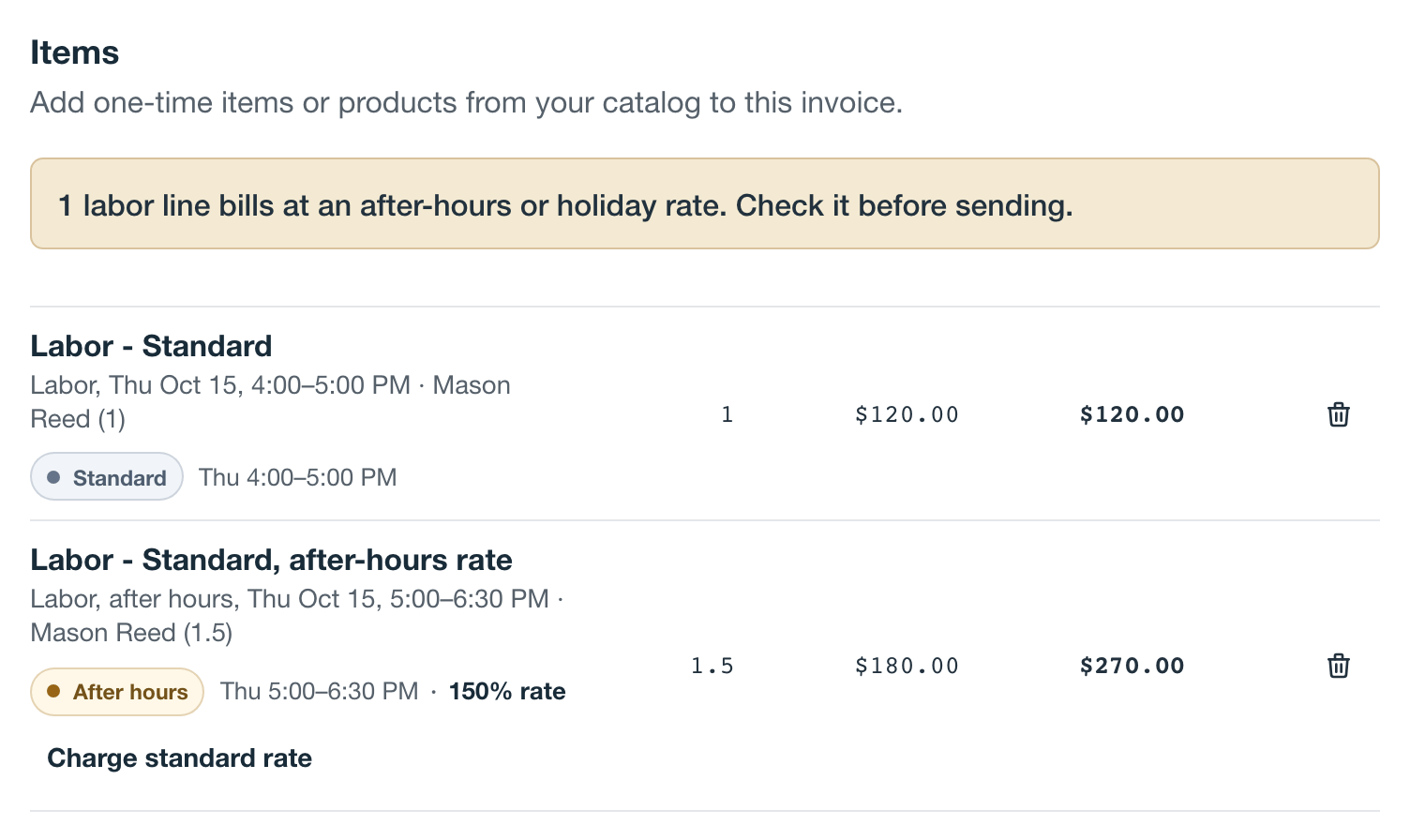
Find and repair the leak under the kitchen sink. Labor is $110 per hour, billed in 15-minute increments, plus materials. We expect the total to be $250 to $500, and we’ll call for your approval before it goes past $500.
Where Stride fits
Stride lets your crew record time and parts against a job from their phones, then use those records to build the invoice. Keeping the details with the job supports billing and gives you actual labor records to review when setting flat rates. Time tracking is in beta and is enabled for your account on request.